Skip to content
Malta Culture logo
  • Destinations
    • Gozo Island
    • Valletta – Malta’s Capital
    • St. Paul’s Bay
    • Buġibba
    • Qawra
    • Rabat
    • The Three Cities
    • Mdina
    • Mellieħa
    • Marsaxlokk
  • Places of Interest
    • The Blue Lagoon
  • Plan a Trip
    • Malta Itinerary planning
    • Things to Do
    • Malta Airport Guide
    • Airport Transfers
    • How to Get Around
    • Buses in Malta
  • Gozo & Comino
    • Visit Gozo Island
    • Visit Comino Island
    • Best Gozo Tours
    • Things To Do In Gozo
    • Taking the Bus in Gozo
    • How to Get to Gozo
    • Best Beaches in Gozo
  • Events
Menu
  • Destinations
    • Gozo Island
    • Valletta – Malta’s Capital
    • St. Paul’s Bay
    • Buġibba
    • Qawra
    • Rabat
    • The Three Cities
    • Mdina
    • Mellieħa
    • Marsaxlokk
  • Places of Interest
    • The Blue Lagoon
  • Plan a Trip
    • Malta Itinerary planning
    • Things to Do
    • Malta Airport Guide
    • Airport Transfers
    • How to Get Around
    • Buses in Malta
  • Gozo & Comino
    • Visit Gozo Island
    • Visit Comino Island
    • Best Gozo Tours
    • Things To Do In Gozo
    • Taking the Bus in Gozo
    • How to Get to Gozo
    • Best Beaches in Gozo
  • Events
Search
Close this search box.

Home » Places of interest » Visiting the St. Paul’s Catacombs in Rabat

Visiting the St. Paul’s Catacombs in Rabat

St Paul’s Catacombs in Rabat are Roman burial grounds dating back to the 3rd century BC.

It is believed they were in use up until the 7th century AD.

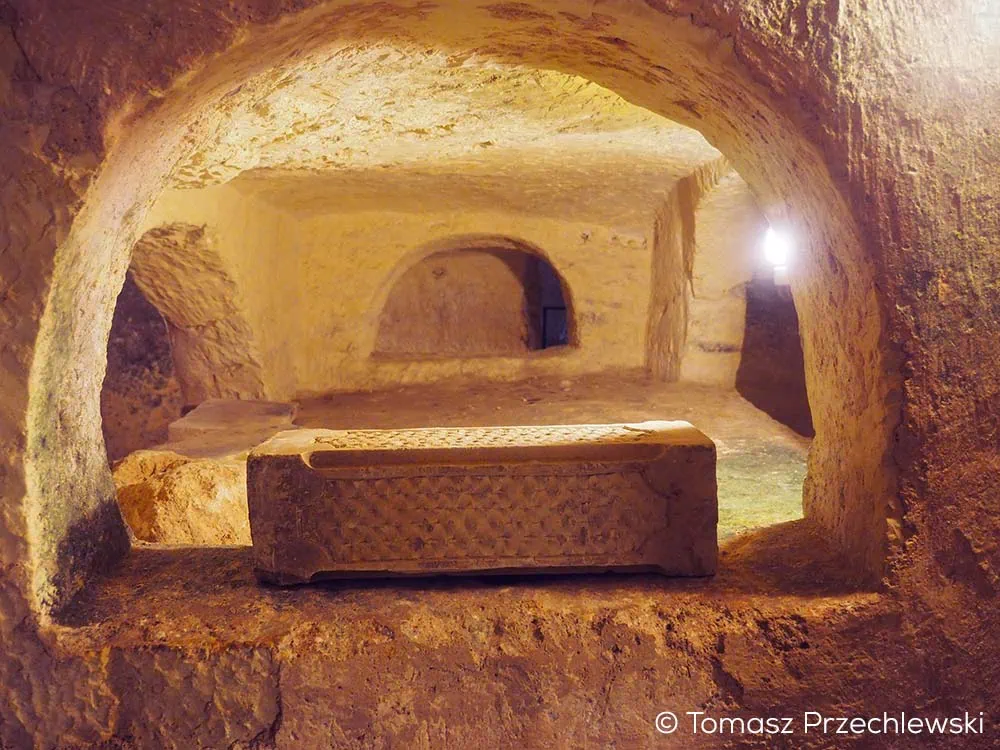
They contain around 30 hypogea or tombs. Later, they were used by Christians first in secret when under persecution and later as a shrine. The catacombs are a fascinating network of tunnels and chambers that offer an insight into cultures that helped to shape Malta as we know it today.
Opening hours
Open daily: 9:00-18:00h (Jun-Oct) & 9:00-17:00h (Nov-May)
Time needed
Min. 1 hour, max. 2.
Wheelchair Access
The visitor centre including the gift shop is wheelchair accessible. Due to the nature of the catacombs, not all of the site is accessible.
Ticket prices
  • Adults (18 – 59 years): €5.00
  • Youths (12 – 17 years): €3.50
  • Seniors (60 years & over), Concessions, and Students: €3.50
  • Children (6 – 11 years): €2.50
  • Infants (1 – 5 years): Free

Table of Contents

Other posts in this section
Detail of the ceiling of the St. John's Co-Cathedral
St. John’s Co-Cathedral: Visiting the gem of Valletta
Inside the St. Paul's Catacombs

Table of Contents

Other posts in this section
Detail of the ceiling of the St. John's Co-Cathedral
St. John’s Co-Cathedral: Visiting the gem of Valletta

Why Visit St. Paul’s Catacombs?

  • Explore over 2000 square meters of catacombs created by the Romans to bury their dead. The St. Paul’s Catacombs are believed to have housed over 1000 bodies and human remains can still be seen. This is the largest Roman burial site in Malta.
  • Gain an understanding of how the catacombs were adapted as Christianity became more widespread and the dominant religion of the island. The catacombs represent the earliest evidence of Christianity in Malta.
  • Understand the ancient history of Malta and the rituals and customs of the Romans
  • Visit the attached museum to see more historic relics.

Where is it?

The catacombs are in the town of Rabat which is very close to Mdina the former capital city of Malta.

The address is St. Agatha Street, Rabat, RBT 2013, in the old part of town and around the corner from the Wignacourt Museum.

There’s no bus stop in the street itself but Rabat is a pretty small town so any bus stop isn’t more than a 5- or 10-minute walk away.

How to Get There

There are plenty of options to get to the catacombs by bus. Here are the best routes.

  • From Valletta take the C2 bus route as this is the fastest and easiest way to get to the catacombs. Other routes are available but they involve changing buses. The C2 route takes around 40 minutes and drop you at Inguanez. The catacombs are a 10 minute walk from the bus stop.
  • From Buġibba head to Wileg and catch either the X3 bus heading towards the airport or the 186 towards Rabat. The X3 drops you in the town while the 186 terminates in the bus station. Either way, the catacombs are a 10-minute walk.
  • From Sliema/St. Julian’s the easiest and most direct way is to catch the TD14 on the Ferries 5 route. This will drop you in the town and takes just over an hour. Again, you will be a 10-minute walk from the catacombs.
  • From Mellieħa, there is no direct route and you will need to change buses at least once. The most direct is to catch the 41 bus towards Valletta. You will need to change at Kungress taking the 202 towards Rabat. According to the timetable, you will only have to wait a few minutes for the 202. The bus takes you to the bus station.

The History of the St Paul’s Catacombs

Under Roman law, the dead could not be buried within the city and as such, they made underground complexes of burial chambers close by. The city of Mdina called Melite during Roman occupation created the burial site at St Paul’s for this purpose. It is believed they were used up until the 7th Century AD. They are the largest Roman burial site in Malta consisting of two large burial chambers containing 30 hypogea or tombs.

The site takes its name from the myth that it was connected to St Paul’s Grotto. It is believed that the catacombs began as a small Punico-Roman burial chamber and expanded haphazardly as needed.

Christian influence can be seen in the form of two large circular tables in the middle of the halls. This is consistent with other Christian burial sites found throughout the world. The table and chairs are carved from living rocks and were used in the annual festival of the dead.

During the Sardonic period, burial customs changed and it is believed the site was abandoned until the 13th century when it was made into a shrine and decorated with murals.

The site was once again abandoned and the main entrance blocked by surrounding developments. In 1812 G.F. Abela managed to access the site and described what he found in his Della Descritione di Malta.

In 1894 archaeologist A.A. Caruana cleared the site of debris and surveyed the complex.
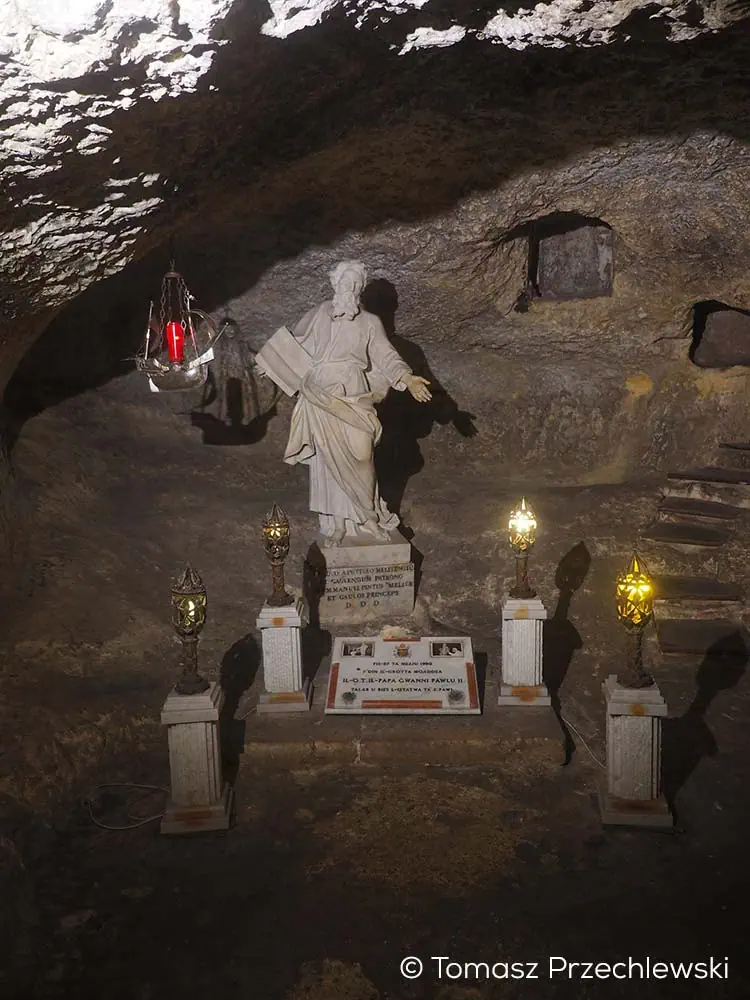
Small statue of St. Paul in the grotto underneath the nearby Wignacourt Museum.
The museum within the St. Paul's Catacombs complex.

Top tips for Visiting

  • Ticket queues are quite common and you don’t want to be part of it. You can buy Heritage Malta Tickets which gives you access to over 20 Heritage Malta site of which the St Paul’s Catacombs are one of them. You can also buy specific passes to Mdina and Rabat which will allow you to plan a trip of the region taking in St Paul’s and other attractions. Click here to purchase.
  • Many visitors have had a better experience if they watch the introduction video in the museum. It highlights point of interest which are easily missed if you just head into the burial ground.
  • It works best if you combine this with a trip to Mdina and Rabat and other attractions such as the St. Cataldus Catacombs which are very close by.
  • There isn’t an awful lot of space down in the catacombs with their low ceilings, so if you’re claustrophobic this might not be a great place to visit. They also involve plenty of stairs which means those in a wheelchair or difficulty walking may not be able to enjoy the whole tour.
  • Some of the catacombs are protected by perspex glass. Pay attention to these areas as they are normally protecting a very interesting part of the catacombs. The introductory video highlights these areas too.
  • Visit the museum as this features historical relics and completes your visit nicely.

The site has landscaped areas where you can picnic. This can make for a nice lunch before heading off on a new adventure.
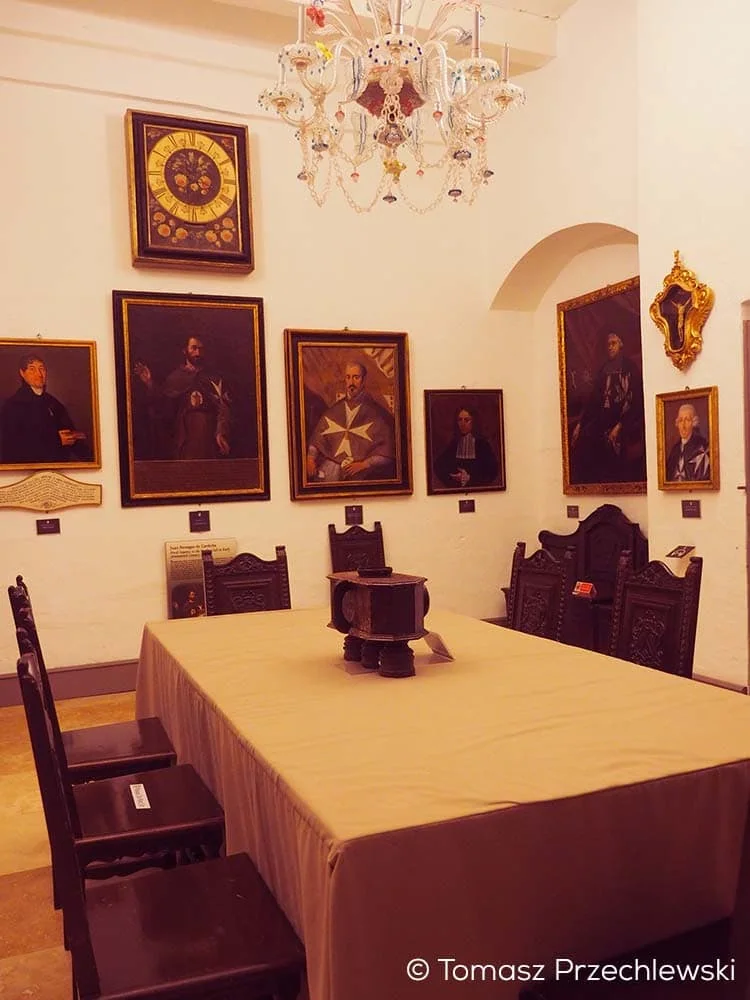
Some of the art on display at the museum.
Facebook
Twitter
Pinterest
WhatsApp
Email
Reddit

Leave a Reply Cancel reply

Your email address will not be published. Required fields are marked *

  • About Us
  • Contact us
  • Privacy Policy
  • Cookies Policy
  • About Us
  • Contact us
  • Privacy Policy
  • Cookies Policy
© 2026 MaltaCulture. All rights reserved.
This website uses cookies to improve your experience. We'll assume you're ok with this, but you can opt-out if you wish.AcceptReject Read More
Privacy & Cookies Policy

Privacy Overview

This website uses cookies to improve your experience while you navigate through the website. Out of these, the cookies that are categorized as necessary are stored on your browser as they are essential for the working of basic functionalities of the website. We also use third-party cookies that help us analyze and understand how you use this website. These cookies will be stored in your browser only with your consent. You also have the option to opt-out of these cookies. But opting out of some of these cookies may affect your browsing experience.
Necessary
Always Enabled
Necessary cookies are absolutely essential for the website to function properly. This category only includes cookies that ensures basic functionalities and security features of the website. These cookies do not store any personal information.
Non-necessary
Any cookies that may not be particularly necessary for the website to function and is used specifically to collect user personal data via analytics, ads, other embedded contents are termed as non-necessary cookies. It is mandatory to procure user consent prior to running these cookies on your website.
SAVE & ACCEPT
Need help planning your trip?

Get a FREE personalized trip plan for Malta from our expert local guides.

Request your free trip plan